

Grief is intensely personal, and no two people experience loss the same, even within the same family. Maggie O’Farrell’s Hamnet, explores this with rare sensitivity. Here, I look at how the film portrays the complex and often conflicting ways we mourn, drawing on both personal and therapeutic perspectives.
Experiencing Grief Through the Ages
I had not read Maggie O’Farrell’s Hamnet, but I studied the Hamlet many years ago and loved it. I wasn’t entirely sure what to expect but knew the film would explore the loss of Will and Agnes’s son, Hamnet. What I wasn’t prepared for was the emotional devastation I would feel after. Jessie Buckley’s performance as Agnes does not merely perform grief, she embodies it. Her grief is raw, unfiltered and impossible to contain. Witnessing this catastrophic event, the depth of Agnes’s sorrow resonated through my own body, which is a testament to the power of the sensory storytelling.
You don’t need prior knowledge of Shakespeare to enjoy this film. Jessie’s sensitive portrayal of the birth and death scenes is enough to carry every viewer through an emotionally immersive journey, making grief tangible.
The Realism of Grief in Hamnet
At it’s core, Hamnet is a story about love and loss. The film’s cinematography makes Agnes and Will’s love story breathtakingly realistic. When their son dies from plague, Agne’s grief erupts. It’s loud, uncontainable, and furious. She blames Will (portrayed by Paul Mescal) who wasn’t there for Hamnet’s final moments, rejects him, and any possibility of comfort through shared mourning. Her anger isn’t cruelty, it’s unbearable loss. Watching this as a therapist, I recognised this a common grief response; when pain has nowhere to go, it often finds its expression in anger and blame.
Parallel Grief: How Loss Divides Families
The film portrays a brutally honest truth: the loss of a child is not a shared experience. Each person mourns the loss of the child they knew, the future they imagined, and the version of themselves that existed before the loss. None of these responses are wrong, yet they make connection almost impossible.
Agnes’s grief is all consuming, while others move, survive, and distract themselves. Agnes struggles to come to terms with her son’s haunting absence and imagines him wandering lost in the abyss. Will’s grief manifests differently. He flees to escape the pain and throws himself into work. His coping method is language and creative expression. Which to Agnes, looks like betrayal, and a failure of love. Yet the film does something rare and generous in its final act—allowing us to see that his absence was not an absence of grief, but a disguise.
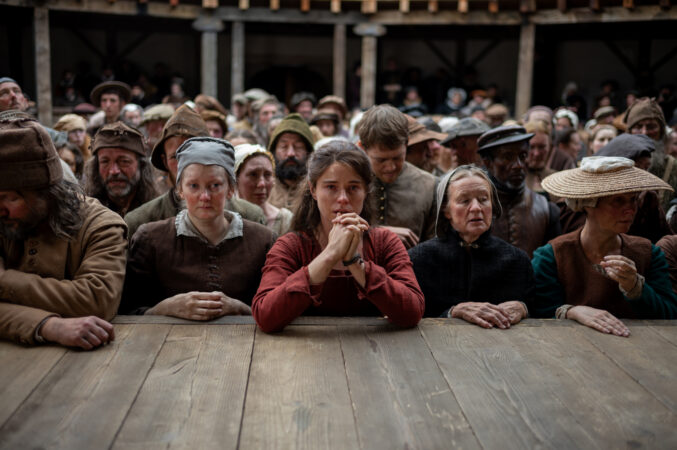
The scenes at the Globe feel less like reconciliation and more like a reframing. Agnes witnesses her husband’s grief visibly for the first time, in a language she could never have spoken herself. Watching Hamlet, she realises he has been mourning their son all along, just not in a way she could recognise. Agnes sees her son emotionally resurrected in front of her eyes which allows her to find a new understanding, and see the truth of Will’s suffering too.
The years of separation still matter. The loneliness still counts. But something fundamental shifts: the belief that she was the only one who loved their child deeply enough to be broken by him. There is something profoundly human and also painful in this truth—that we can love the same person, lose the same child, and still mourn in incompatible ways.
The final scene is tender, haunting, and unforgettable. We watch transfixed as both parents’ grief intersects, allowing them to acknowledge each other’s loss and to say goodbye. It captures one of the most moving truths about mourning: love survives, even when grief takes incompatible shapes. It is one of the most moving scenes in a film I have witnessed.
Lessons on Grief from Hamnet
In my work with bereaved clients, I often see this moment of parallel grief mirrored, and the isolation felt when parents, partners, siblings grieve differently. Hamnet captures this with immense sensitivity, and reminds us that there is no correct or single way to mourn. Therapy can make it possible to understand love and grief can co-exist, which can bring both comfort and insight to those navigating loss.
If you feel you could benefit from some counselling, please get in touch here
 Ashtead & Leatherhead Counselling